
On Thursday February 25, the $405-billion a year retailer Walmart held a live broadcast, moderated by TreeHugger, announcing a major step toward its sustainability mission. Though they have made previous efforts to be more sustainable, this was their first commitment to specifically reduce greenhouse gases, promising to eliminate 20 million metric tons of greenhouse gases from their global supply chain by the end of 2015. This action is a result of five years of collaboration with EDF (Environmental Defense Fund) and others. (The webcast of the announcement can be viewed here.)
In order to make this goal a reality, Walmart plans to ask their estimated 100,000 companies that supply it to cut the amount of carbon they emit when they produce, package, and ship their products. This is an incredibly hefty demand, affecting every step of the manufacturing process from raw materials to recycling.
Though Walmart's goal is commendable, their method of achieving it will be adding an extreme amount of pressure more on their suppliers, rather than on themselves. Their reason for this approach is explained in their press release, stating "the footprint of Walmart's global supply chain is many times larger than its operational footprint and represents a more impactful opportunity to reduce emissions." Because this is such a new concept with large areas of uncharted territory, the details of how Walmart will manage this and support their suppliers with these adjustments is yet to be described.
It is understandable that the most efficient way to reduce greenhouse gases is through their global supply chain. However, as Stacy Mitchell, a senior researcher with the New Rules Project, argues, "Walmart continues to deflect attention from the enormous greenhouse gas implications of its own business model." Walmart's Responsibility Report shows that their carbon emissions have only grown within the last five years as they resisted pressures to reduce its own greenhouse gas emissions. It is a bit ironic that they are asking their suppliers to cut down, when they are doing more harm now than they were three or five years ago.
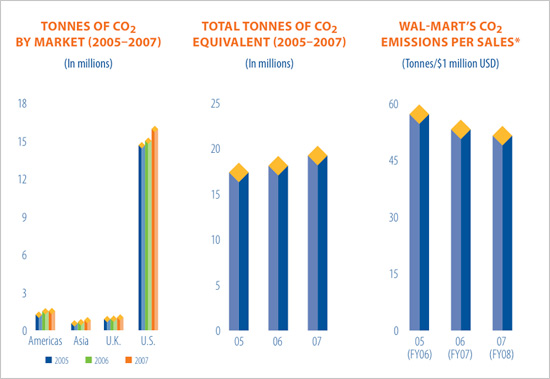
However, one cannot be quick too judge and disregard this recent announcement. Although we do not support many of Walmart's social and business policies, we can still appreciate the direction it is moving toward. Some critics may argue that Walmart is only making these changes as a business advantage and their sustainability approach is a mere marketing strategy. However, regardless of their motives, this is still a move that is beneficial for our planet. Even if Walmart's main concern is for financial gain, this step benefits the earth, protects our environment, and preserves our natural resources.
In addition, because of Walmart's scale, any relatively small change leads to big reductions. For example, several years ago, Walmart asked 20th Century Fox Home Entertainment to make their plastic packaging lighter. They agreed, and eventually, the new lighter packaging was used for software and games. And this was applied not solely for Walmart, but for every other supplier as well. As Walmart works with many of the world's biggest companies, they have an incredible amount of influence in other business practices. Furthermore, as more than a third of all Americans shop at Walmart every week, they influence a large group of consumers' attitudes and habits in the home. The scale of Walmart is enormous; it employs 2 million employees worldwide, has 8,100 stores internationally, and is supplied by 30,000 factories in China. Despite the negative connotations of a mass retail chain store, one cannot ignore the weight of influence it can have on the world.

As Michelle Harvey of EDF states, "it's getting harder and harder to hate Walmart." The steps Walmart is taking encourages us that sustainability is moving forward, as long as it remains affordable and profitable. As a corporation as large as this, it is guaranteed that there will be a positive rippling effect.


