Showing posts with label china. Show all posts

Wednesday, January 12, 2011

East Meets West, "A Focus on China" (Part 2)

*This article is a continuation of a 2 part series. To read Part 1, please click here.
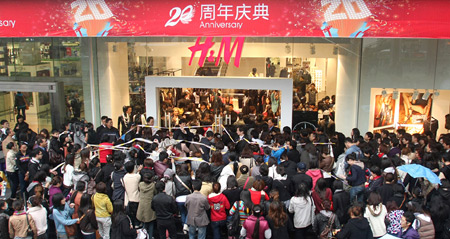
photo via: China Daily 

With better wages and the convenience of being able to live together with their families, (something the working class of the Western world never really had to think about), China is heading toward a rise of a populous middle class and a hungry appetite for consumer spending. For example, Zara and H&M, two of the world's largest fast fashion retailers, have seen a huge success this year. H&M is ending this year with a total of 13 new stores, leading to a total of 27, while Zara opened 33 new stores, leading to a total of 60. As the country is becoming more fashion-conscious, these fast fashion retailers are thriving.

 In contrast, there is also a new consumer base of young, creative individuals who are looking rather inward to find designs that reflect China's culture and artistry. Young, 20s-30s year olds in China are now looking toward homegrown fashion that reflect a distinctive modern perspective: one that melds Western fashion sense with Chinese culture. We end this 2-part series highlighting a few of their rising stars:


One up and coming designer in Shanghai's burgeoning fashion scene is Jenny Ji, who has taken the East-meets-West concept and created a modern Chinese lifestyle brand with her ready-to-wear line "La Vie" as well as a wedding line, aptly called, "The Wedding." 29-year old Jenny Ji started her line La Vie eight years ago after studying fashion abroad in Milan and assisting a Japanese designer in Hong Kong. With stores on Tai Kang Lu in Shanghai's French concession and the Bund as well as an international presence in Paris and Stockholm, La Vie has created a buzz domestically and internationally. Asked about her sources of inspiration, she explained, "Every time we recreate our design concepts, our inspiration comes from a piece of Chinese culture. [Our] winter fashion collection [for 2010] was based on peacock feather, which are used in many Shanghai homes for decoration."

photo via: La Vie

In addition to utilizing a distinctively Chinese perspective to her designs, Ji is also known as an ethical fashion designer, using eco-friendly fabrics for her lines. "I insisted on eco-friendly materials...It's very comfortable and you can feel the difference," Ji explains, "We want La Vie to be an environmentally friendly brand, but from the business side, we also think this is the future." In La Vie's Fall/Winter 2011 collection titled "Calender Girl," Ji utilized common colors used by the Chinese: Black, Red and White and elements of the traditional "Cheongsam" in modern, Western silhouettes, melding East and West.

While the idea of sustainability is still trying to catch on in China, one store in Shanghai that has taken sustainability to the next level is Nest on Tai Kang Lu in the French Concession district in Shanghai. Dedicated to offering a range of eco-friendly products for the individual and home, Nest comprises of Chinese as well as foreign designs, aimed at supporting "the work of skilled artisans of China and in Asia." Begun by Trine Targett, a Danish native, who sought to contemporize the crafts of traditional Chinese artisans, Nest has become a design incubator and showcase for Chinese-made sustainable design, through its "Design Talk Evenings." The manifesto of Nest is that "the sum is greater than its parts." While sustainability still has a long way to go in China, the fact that there is a store for the purpose of selling exclusively sustainable products is significant, signaling a customer base in Shanghai that is interested in eco-friendly products.

Photo Via: Judy Hua

photo via: Art Zine China

Another designer that caters to an East-meet-West perspective is Judy Hua. The designer Hua Juan uses elements of Chinese art, while maintaining a modern, funky edge. She is especially known for her wedding dresses, wedding accoutrements, and custom ready-to-wear. For her Spring/Summer 2010 collection, Hua Juan was inspired by Chinese contemporary artist Zhou Chunya's Peach Blossom paintings, which depict peach blossoms and red-shaped men embracing pink-colored women. Evidence of this could be seen in the color combinations, accessories and makeup on the runway. The color combinations were distinct: white cocktail dresses with magenta shoulder pieces, magenta dresses with black blazers as well as colorful floral print dresses. Each model was outfitted with a magenta headband and had heavy, magenta eyeshadow streaked across their eyes. Instead of looking abroad for inspiration, Judy Hua looked at Chinese contemporary art, offering a unique aesthetic to the fashion community.

photo via: Chinese Coat

photo via: Eblis Hungi

In contrast, clothing brand Eblis Hungi, located on Changle Road in Shanghai's French Concession district, infuses Western men's street wear with a slight Asian sensibility, rather than the more typical East-meets-West perspective. For example, the prints used on Eblis Hungi's hoodies are patterned and sequenced similarly to traditional Chinese prints, while using a cheetah print and their logo: a mummified bean-shape. In addition, the graphics on their t-shirts show a mummified character wearing traditional Chinese garb. Overall, the color used in their graphics and clothing as well as the color combinations definitely allude to a colorful and ornate Chinese aesthetic. For example, the color combinations on their graphic tees are similar to the color combinations used in traditional Chinese buildings such as those in the Forbidden City. In contrast to La Vie and Judy Hua, Eblis Hungi reflects a translating of Western-style for the young, Chinese consumer, rather than a mixing of East and West.

As China is becoming increasingly more important in the fashion community, we can already see a number of young, creative designers who are eager to test the waters and make their mark both locally and globally. While there are many Western brands venturing into the Eastern world, there are just as many Chinese-born designers who are excited to have their designs recognized and worn by their community. Who knows, maybe some day, these designers will have their goods stocked and sold here in the States!

Wednesday, December 1, 2010

The Future of Cheap Labor, "A Focus on China" (Part 1)

This is the first of a two-series blog focusing on the latest developments of China. Please stay tuned for the follow-up blog post: East Meets West, Part 2 of "A Focus on China."


photo via: Time.com

Without a doubt, China is the country of 2010. With their spectacular economic growth just within the last thirty years, they have already completed large improvements in their infrastructure, redesigning buildings, airports, and streets. So as the standard of living has been raised, a quickly growing upper and middle class have followed suit. Hence, a focus on growing the domestic Chinese market is, and has been, on every smart businessman's mind.

Some of you may remember our blog post a few months back in regards to China's growing fashion scene and Hermes' new strategy of creating a special brand specifically for the Chinese market. We briefly discussed the expectation of a new niche of stylish Chinese individuals with an increasing demand for luxury fashion and Chinese-based designer goods. We speculated major changes within China; and since then, the country has always been on our radar. So today we follow up with an updated post with our latest thoughts and what to expect.

photo via: Time.com

As the Chinese economy continues to boom, factories all over the country have been on strike requesting higher wages and better working conditions. Just google search "Chinese factories strike" and you are sure to end up with dozens of articles linking multiple companies recently affected by their workers demanding double, or even triple the wage they used to receive for their hard labor. Foxconn, the world's largest electronics contract maker, made headlines as a string of suicides among their workers became public. Since then, Foxconn, along with many other factories increased their workers' wages by up to 66 per cent.

photo via: USA Today

As China now stands as the second largest economy in the world, their manufacturing industry is changing rapidly as workers will no longer accept the poor working conditions and low wages they used to receive for the last several decades. As a result of higher production costs, many companies who were once so dependent on China's low production costs have either relocated their business to alternative countries who can provide lower costs, such as Vietnam, India, Bangladesh, and multiple South American countries, or increased their product prices and/or altered the designs. For retailers sourcing cotton, it also does not help that the price of cotton rose almost 80 percent since July and prices are expected to remain high.

With the new labour laws and the need to provide competitive production prices, there is a rising trend of factories relocating from their coastal locations to central China. In 2009, there were 90.8 million migrant workers in the coastal eastern part of China, a drop of about 8.9 per cent from the previous year. The number of migrant workers in western China increased by 35.8 percent, reaching 29.4 million, according to the National Bureau of Statistics of China. In the past, the eastern coastal cities were the driving force of the economic development. However, as factories continue to move more inland, many workers no longer have to live in migrant workers' dormitories and can easily commute to work on a daily basis. As most factory workers used to travel more than 2,000 kilometers away from home and lived apart from their families, the relocation to move inland is a drastic change to thousands of people's lives.

So what does this all mean for those of us in the fashion circle? As production standards raise, does "Made in China" hold a new perspective? As retailers have been doing business in China for decades, the quality of Chinese-made goods have steadily increased. As it already has proper infrastructure, it is in much better condition in comparison to other Asian and South American countries. Some are looking to develop in Africa, but it will still be years before getting things up and running. And as many companies are finding cheaper alternative in these countries, Chinese made goods are considered more reliable.

Honda workers on strike, photo via: Wall Street Pit (LA Times Photo)

This change also brings up the future of cheaply made clothes and it's lack of sustainability. How long will retailers continue moving their production from one country to the next? China is not the only one in protest as there were a quiet but steady increase of strikes all over the world this past year, including India, Vietnam, and Cambodia, just to name a few. Retailers cannot depend on cheap labor as a long-term investment and must rethink their profit margins. And as we live in a more transparent society, there is a social and environmental responsibility that these large conglomerates must uphold. Expecting workers to work long hours doing monotonous routines with very little pay is dehumanizing, treating the worker more like a machine rather than a human being. The production systems of the 90's are out of date and will not work in the times of today.

Foxconn employees, photo via: Wall Street Pit (Bloomberg photo)

The increased price for production and labor is only a small fraction of what is to come over the next several years. As China continues to reconfigure their manufacturing businesses, the future of the world's production system no longer remains the same. Hopefully, these adjustments will allow an improved quality of life for many of these factory workers. The only question is, will we, as consumers, be able to accept this change?

Saturday, October 30, 2010

comparative advantage

Ask almost any European about the history of their continent, and they will at the very least be able to tell you about some of the past rivalries between countries. The one between England and France has been ongoing for centuries. However, ask those same Europeans about rivalries, past and present, in Asia, and you are likely to draw a blank. The more knowledgeable will cite the rivalry, which

Friday, May 7, 2010

car culture

The Beijing Motor Show was being held while my wife and I were in Beijing. Of course, we didn’t attend, but I did come across an interesting news item on the subject. Apparently, the top-of-the-range models from Mercedes, Audi and BMW are made six inches longer for the China market than for all other markets. What use is made of this extra length? It turns out that it all goes to providing extra

wonderful

When you approach the Great Wall of China at Badaling, near Beijing, you cannot fail to notice a number of very large plaques set into a retaining wall. One informs the visitor that the Great Wall is a UNESCO world heritage site, while another proclaims this spectacular piece of peripatetic architecture to be one of the New Seven Wonders of the World.

Few people can name all seven of the

Friday, April 30, 2010

keep off the grass

When I was young, I can remember my local park featuring several small signs bearing the legend “keep off the grass”, but when I went to a big city for the first time I found that open expanses of grass were somewhere to sit and bask in the sun, on the rare occasions when that busy old fool bothered to put in a reluctant appearance. In Beijing, things are rather different.

In the small park that

Thursday, April 29, 2010

social contract

As someone from a semi-rural background, I’m a big fan of urban parks. Some, like Hyde Park in London and Central Park in New York, have an international reputation, but the really interesting ones are those that are unknown outside their immediate neighbourhood and are there simply as an amenity for the local population. We came across one such local park on our recent trip to Beijing, directly

Wednesday, April 28, 2010

extramural activities

Before I visit a place for the first time, I usually construct a mental map. This isn’t a conscious process, merely the synthesis of a series of impressions gained from books, magazines, newspapers, television—the usual sources—and information picked up as a result of visits to other places that I have deemed to be similar. I don’t know why I bother, because I’m invariably wrong. When I came to

Tuesday, April 27, 2010

northern capital

This is not a discussion about collateralized debt obligations, credit default swaps or other larcenous forms of financial legerdemain. In fact, ‘northern capital’ is the literal translation of Beijing, where my wife and I have spent the last five days, just as ‘southern capital’ is the literal translation of Nanjing, the Chinese capital during several important periods in Chinese history, most

Friday, January 22, 2010

confucius he say...

Very little that happens in Hong Kong makes the news internationally. Stories that do invariably have a sensationalist angle to them, such as the case of the phantom acid thrower, which made the BBC’s World News recently probably because in the latest attack tourists were among the injured. Another example is the sordid wranglings over the will of eccentric billionaire Nina Wang, Asia’s richest