Showing posts with label shanghai. Show all posts

Wednesday, January 12, 2011

East Meets West, "A Focus on China" (Part 2)

*This article is a continuation of a 2 part series. To read Part 1, please click here.
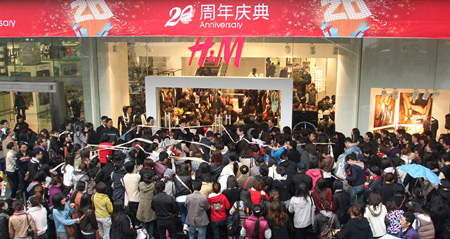
photo via: China Daily 

With better wages and the convenience of being able to live together with their families, (something the working class of the Western world never really had to think about), China is heading toward a rise of a populous middle class and a hungry appetite for consumer spending. For example, Zara and H&M, two of the world's largest fast fashion retailers, have seen a huge success this year. H&M is ending this year with a total of 13 new stores, leading to a total of 27, while Zara opened 33 new stores, leading to a total of 60. As the country is becoming more fashion-conscious, these fast fashion retailers are thriving.

 In contrast, there is also a new consumer base of young, creative individuals who are looking rather inward to find designs that reflect China's culture and artistry. Young, 20s-30s year olds in China are now looking toward homegrown fashion that reflect a distinctive modern perspective: one that melds Western fashion sense with Chinese culture. We end this 2-part series highlighting a few of their rising stars:


One up and coming designer in Shanghai's burgeoning fashion scene is Jenny Ji, who has taken the East-meets-West concept and created a modern Chinese lifestyle brand with her ready-to-wear line "La Vie" as well as a wedding line, aptly called, "The Wedding." 29-year old Jenny Ji started her line La Vie eight years ago after studying fashion abroad in Milan and assisting a Japanese designer in Hong Kong. With stores on Tai Kang Lu in Shanghai's French concession and the Bund as well as an international presence in Paris and Stockholm, La Vie has created a buzz domestically and internationally. Asked about her sources of inspiration, she explained, "Every time we recreate our design concepts, our inspiration comes from a piece of Chinese culture. [Our] winter fashion collection [for 2010] was based on peacock feather, which are used in many Shanghai homes for decoration."

photo via: La Vie

In addition to utilizing a distinctively Chinese perspective to her designs, Ji is also known as an ethical fashion designer, using eco-friendly fabrics for her lines. "I insisted on eco-friendly materials...It's very comfortable and you can feel the difference," Ji explains, "We want La Vie to be an environmentally friendly brand, but from the business side, we also think this is the future." In La Vie's Fall/Winter 2011 collection titled "Calender Girl," Ji utilized common colors used by the Chinese: Black, Red and White and elements of the traditional "Cheongsam" in modern, Western silhouettes, melding East and West.

While the idea of sustainability is still trying to catch on in China, one store in Shanghai that has taken sustainability to the next level is Nest on Tai Kang Lu in the French Concession district in Shanghai. Dedicated to offering a range of eco-friendly products for the individual and home, Nest comprises of Chinese as well as foreign designs, aimed at supporting "the work of skilled artisans of China and in Asia." Begun by Trine Targett, a Danish native, who sought to contemporize the crafts of traditional Chinese artisans, Nest has become a design incubator and showcase for Chinese-made sustainable design, through its "Design Talk Evenings." The manifesto of Nest is that "the sum is greater than its parts." While sustainability still has a long way to go in China, the fact that there is a store for the purpose of selling exclusively sustainable products is significant, signaling a customer base in Shanghai that is interested in eco-friendly products.

Photo Via: Judy Hua

photo via: Art Zine China

Another designer that caters to an East-meet-West perspective is Judy Hua. The designer Hua Juan uses elements of Chinese art, while maintaining a modern, funky edge. She is especially known for her wedding dresses, wedding accoutrements, and custom ready-to-wear. For her Spring/Summer 2010 collection, Hua Juan was inspired by Chinese contemporary artist Zhou Chunya's Peach Blossom paintings, which depict peach blossoms and red-shaped men embracing pink-colored women. Evidence of this could be seen in the color combinations, accessories and makeup on the runway. The color combinations were distinct: white cocktail dresses with magenta shoulder pieces, magenta dresses with black blazers as well as colorful floral print dresses. Each model was outfitted with a magenta headband and had heavy, magenta eyeshadow streaked across their eyes. Instead of looking abroad for inspiration, Judy Hua looked at Chinese contemporary art, offering a unique aesthetic to the fashion community.

photo via: Chinese Coat

photo via: Eblis Hungi

In contrast, clothing brand Eblis Hungi, located on Changle Road in Shanghai's French Concession district, infuses Western men's street wear with a slight Asian sensibility, rather than the more typical East-meets-West perspective. For example, the prints used on Eblis Hungi's hoodies are patterned and sequenced similarly to traditional Chinese prints, while using a cheetah print and their logo: a mummified bean-shape. In addition, the graphics on their t-shirts show a mummified character wearing traditional Chinese garb. Overall, the color used in their graphics and clothing as well as the color combinations definitely allude to a colorful and ornate Chinese aesthetic. For example, the color combinations on their graphic tees are similar to the color combinations used in traditional Chinese buildings such as those in the Forbidden City. In contrast to La Vie and Judy Hua, Eblis Hungi reflects a translating of Western-style for the young, Chinese consumer, rather than a mixing of East and West.

As China is becoming increasingly more important in the fashion community, we can already see a number of young, creative designers who are eager to test the waters and make their mark both locally and globally. While there are many Western brands venturing into the Eastern world, there are just as many Chinese-born designers who are excited to have their designs recognized and worn by their community. Who knows, maybe some day, these designers will have their goods stocked and sold here in the States!

Wednesday, December 1, 2010

The Future of Cheap Labor, "A Focus on China" (Part 1)

This is the first of a two-series blog focusing on the latest developments of China. Please stay tuned for the follow-up blog post: East Meets West, Part 2 of "A Focus on China."


photo via: Time.com

Without a doubt, China is the country of 2010. With their spectacular economic growth just within the last thirty years, they have already completed large improvements in their infrastructure, redesigning buildings, airports, and streets. So as the standard of living has been raised, a quickly growing upper and middle class have followed suit. Hence, a focus on growing the domestic Chinese market is, and has been, on every smart businessman's mind.

Some of you may remember our blog post a few months back in regards to China's growing fashion scene and Hermes' new strategy of creating a special brand specifically for the Chinese market. We briefly discussed the expectation of a new niche of stylish Chinese individuals with an increasing demand for luxury fashion and Chinese-based designer goods. We speculated major changes within China; and since then, the country has always been on our radar. So today we follow up with an updated post with our latest thoughts and what to expect.

photo via: Time.com

As the Chinese economy continues to boom, factories all over the country have been on strike requesting higher wages and better working conditions. Just google search "Chinese factories strike" and you are sure to end up with dozens of articles linking multiple companies recently affected by their workers demanding double, or even triple the wage they used to receive for their hard labor. Foxconn, the world's largest electronics contract maker, made headlines as a string of suicides among their workers became public. Since then, Foxconn, along with many other factories increased their workers' wages by up to 66 per cent.

photo via: USA Today

As China now stands as the second largest economy in the world, their manufacturing industry is changing rapidly as workers will no longer accept the poor working conditions and low wages they used to receive for the last several decades. As a result of higher production costs, many companies who were once so dependent on China's low production costs have either relocated their business to alternative countries who can provide lower costs, such as Vietnam, India, Bangladesh, and multiple South American countries, or increased their product prices and/or altered the designs. For retailers sourcing cotton, it also does not help that the price of cotton rose almost 80 percent since July and prices are expected to remain high.

With the new labour laws and the need to provide competitive production prices, there is a rising trend of factories relocating from their coastal locations to central China. In 2009, there were 90.8 million migrant workers in the coastal eastern part of China, a drop of about 8.9 per cent from the previous year. The number of migrant workers in western China increased by 35.8 percent, reaching 29.4 million, according to the National Bureau of Statistics of China. In the past, the eastern coastal cities were the driving force of the economic development. However, as factories continue to move more inland, many workers no longer have to live in migrant workers' dormitories and can easily commute to work on a daily basis. As most factory workers used to travel more than 2,000 kilometers away from home and lived apart from their families, the relocation to move inland is a drastic change to thousands of people's lives.

So what does this all mean for those of us in the fashion circle? As production standards raise, does "Made in China" hold a new perspective? As retailers have been doing business in China for decades, the quality of Chinese-made goods have steadily increased. As it already has proper infrastructure, it is in much better condition in comparison to other Asian and South American countries. Some are looking to develop in Africa, but it will still be years before getting things up and running. And as many companies are finding cheaper alternative in these countries, Chinese made goods are considered more reliable.

Honda workers on strike, photo via: Wall Street Pit (LA Times Photo)

This change also brings up the future of cheaply made clothes and it's lack of sustainability. How long will retailers continue moving their production from one country to the next? China is not the only one in protest as there were a quiet but steady increase of strikes all over the world this past year, including India, Vietnam, and Cambodia, just to name a few. Retailers cannot depend on cheap labor as a long-term investment and must rethink their profit margins. And as we live in a more transparent society, there is a social and environmental responsibility that these large conglomerates must uphold. Expecting workers to work long hours doing monotonous routines with very little pay is dehumanizing, treating the worker more like a machine rather than a human being. The production systems of the 90's are out of date and will not work in the times of today.

Foxconn employees, photo via: Wall Street Pit (Bloomberg photo)

The increased price for production and labor is only a small fraction of what is to come over the next several years. As China continues to reconfigure their manufacturing businesses, the future of the world's production system no longer remains the same. Hopefully, these adjustments will allow an improved quality of life for many of these factory workers. The only question is, will we, as consumers, be able to accept this change?

Wednesday, August 25, 2010

China's Burgeoning Fashion Scene

"Let China sleep, for when she wakes, she will shake the world." -Napoleon Bonaparte

Napoleon was way ahead of his time when he stated this quote some 200 years ago as it is slowly unraveling into a reality today. Having recently passed Japan as the second largest economy in the world, China introduces itself to the world as a new economic superpower. And although the country is still far from developed, experts say that China will pass the United States as the world's biggest economy as early as 2030. 

So as more Chinese are becoming millionaires, it is only natural that there is a fast-growing demand for luxury goods and upscale fashion. And because so many Chinese went from nothing to everything, most of the wealthy are all about showing off their riches and dressing in garish head-to-toe designer looks. As
Wang Deyuan, the owner of one of the top ad agencies in southern China shares with Times, "You have to show you have money, otherwise no one believes that you're rich." 

So it is no wonder that the more discrete, sans-logo luxury items are not appealing to the Chinese market. A Louis Vuitton worker reports that the new epi leather collection lacking any obvious LV logos was not a popular purchase for the Chinese. Though these pieces all cost more than 10,000 yuan (US $1,476) and therefore considered high-end, the most popular items were rather the older designs that had a prominent LV logo. A Clerk at the Gucci store at Shanghai Times Square also explained that the "Techno Horsebit" series, which doesn't have any obvious logos, hasn't had many buyers either.

Clearly, the meaning of understated elegance has not yet infiltrated the wealthy Chinese market, leaving major fashion brands having to decide if they need to create different collections for the Chinese market, as it is apparent that most Chinese shoppers do not have the same mentality as the European or the North American.

 However, we can expect that in the next several years, there will be a growing number of the upper class that will mature in their taste level and opt for a more sophisticated, refined sense of style. And we see this already in a small, but growing number of young, fashion-forward Chinese men and women creating the future of Chinese fashion whether it is through their own clothing line, a fashion blog, or street style photography. And while we are aware that this is still a very small percentage of China, we can expect that this subculture will only expand as China continues to rise in economic wealth.

So who are these Chinese bloggers and fashion designers? Take a look of our favorite picks of established and rising talents of China today. 

photo via: Stylites

Stylites, a two year old blog by Nels Frye, is a source of information for readers across the globe on the current style and pop culture trends of China. Frye's photos have appeared in Chinese Vogue, Grazia, Beijing Walk, The Beijinger, and several other publications. He likes to describe his blog as "a document of what Beijing pedestrians wear, think, and do."

photo via: I Am Small Fry

With over 10,000 hits per post, Sammy of I Am Small Fry is one of the most popular posters on Wodeyichu, a fashion community site where young Chinese women can share their personal style and wardrobe. Her broad collection ranging everywhere from Comme des Garcon, Alaia, to vintage Celine makes her a top fashionista in the Chinese fashion blog scene.

Fossilized Seed by Erica Ji is another popular blog with an interesting feature of introducing local Chinese designers and is therefore valuable in helping domestic designers build recognition in their homeland as well as overseas. She also highlights global fashion trends and uploads her personal style for her readers.

Although European brands dominate the high fashion scene in China, there is a growing number of domestic brands names fighting to gain visibility both in their homeland as well as in the international community. While the first China Fashion Week held last fall of 2009 was not so well received in the fashion world, here are a few creative talents we spotted that have a lot of potential.

Shoes by Guo Pei, Photo via: Trend de la Creme

An acknowledged leader of haute couture in China, Guo Pei is a designer for the country's top celebrities and upper class. Her Beijing-based store, Rose Studio, opened in 1997; and since then, it boasts more than 1,000 regular customers who buy up to 30 to 40 dresses a year.

photo via: White Collar

As a pure local brand of Beijing, WHITE-COLLAR has been in the business for 12 years and is one of China's most successful domestic fashion brands, with increased profits every year. Rather than focusing so much on profit-making, Zhenyu Dong, the General Manager of WHITE-COLLAR, works on building customer loyalty, brand identity, and aiming toward building Beijing into one of the world's fashion capitals. WHITE-COLLAR was also chosen to close China's first ever Fashion Week held last November 2009.


photos via: Yatzer

Li Xiaofeng is a Beijing artist who creates sculptural clothing pieces made from traditional Chinese ceramics. His most recent collaboration is with Lacoste, featuring a limited edition polo shirt that features a fractured digital print of photographed porcelain shards. 

photo via: Not Just A Label

Famed for her innovative performance at the annual graduate CSM exhibition show showcasing white garments that illuminate in the dark, Vega Zaishi Wang, a recent graduate of Central Saint Martins, opened her first store in Jianwai Soho last week. Integrating technology into her designs, Ms. Wang brings an innovative sense of style to the Chinese fashion scene.

Whether or not Beijing or Shanghai will become one of fashion's capital, we are excited to witness the burgeoning fashion scene in a country with such rapid change and growth. Though this is all we have for you today, we will be keeping our eyes open with what's going on in the other side of the globe, and you can expect to see another update on the latest Chinese fashion news soon.

Thursday, August 12, 2010

Overcoming Obstacles Through Creative Strategies

To some, the recession may be a distant memory of the past, but to most retailers, the effects of it's sting remains painfully present. As unemployment is still high, house values are low, and banks continue to be less reluctant to lend to consumers, the majority of people are shopping with caution.

And while many retailers in return have slashed their prices for the bargain hungry, a few have risen above the norm and put their creativity at the forefront of their business strategies to bring back their business. Today we highlight three brands that have taken an unordinary approach in response to today's market and show that you don't always need to resort to lower prices in order to stay afloat.

image via: NY Times
1. Luxottica 
The $6.6 billion Italian-based eyewear company with retail outlets including Sunglass Hut and LensCrafters experiments with a concept store that makes eyewear shopping a full on event. Their first store Eye Hub opened three weeks ago in Hawthorne, Australia with hopes of building ten to fifteen more in the United States, China, and Britain, over the next three years.

Costing two to three times as much as a regular LensCrafters store in the US, the Eye Hub functions beyond a traditional retail store and is more like a live research and development lab. Customers are first greeted by the concierge who then gives a short lesson about the store from a Web home page. From there, they are asked how they would like to interact with the store. From the initial entrance at the store to the final purchase, everything is all about having a personal experience.

image via: NY Times

For those who are looking for sporty eyewear, there are wind machines, treadmills, and machines that stimulate glare on snow or water so customers can actually test out the products in specific conditions. There are also 41 touch screens that function as both mirrors and cameras so people can not only just see how they look in photos, but also send them out to Facebook or other websites to ask for a friend's advice before making the final purchase.

Similar to the Apple stores, the Eye Hub has something like the Genius Bar where a section is designated as a center for eye problems and prescriptions. There are also salespeople walking around the store who can make your final transactions so you don't necessarily need to wait in line at a cash register to make a purchase.

Experimenting with new ideas during today's economic state is rare, making Luxottica stand out against the crowd. But will this new shop encourage customers to buy a product and not just visit for the experience? Only time will tell. (source: NY Times)

photo via: Financial Times

2. Hermès
Famed for its Kelly and Birkin bags, the Hermès brand takes an unusual move with a launch of a new brand in China in September. Shang Xia, translated as "up and down" in English, would remain completely separate from the main Hermès line and would be branded as completely Chinese.
Florian Craen, the Hermès managing director in North Asia, describes, "it is developed in China with the Chinese team, based on Chinese craftsmanship and broadly made in China."

This is an interesting approach to getting into the Chinese market. According to Shaun Rein of China Market Research group in Shanghai, most Chinese consumers do not want made-for-China products. Studies have shown that shoes, handbags, and jewellery that are of foreign design sell much better than local market products. Perhaps for these reasons, Shang Xia will start by selling home products such as tableware and furniture with a traditional Chinese theme. Whether or not they will expand to fashion remains unknown. The growth of the company will be determined by how it sells in the market. (source: FT.com)

3. Nike+
With the technological innovations of today, many brands have began interacting more with the web to promote new marketing campaigns and advertisements. Facebook, Twitter, and other forms of social media have been the biggest influencers of change for brands today. However, Nike has taken this idea to a whole new level with Nike+, integrating digital technology into their actual products. Nike+ uses digital sensors integrated into running shoes to measure, analyze, and share performance data. It also has a program for iPods made especially for runners who like to listen to music during their workout. Since its launch, it has sold 2.5 million Nike+ kits. Not only has this been a financial asset to Nike, but has created a deeper relationship between its brand and their consumers.

                     
video via: YouTube

More recently, at the start of the last World Cup, Nike also launched a new football boot called the Mercurial Vapor SuperFly II. It came with an access code for Nike Soccer+, a digital coaching program available via web or any smart phone. Players can log in and watch instructions given by world-class players and coaches. As the Nike Soccer general manager states, "you are not just buying a boot, you are buying a total game improvement package." Nike represents the new, modern product of today. The brand is no longer just about the product, but the total experience, and incorporating the experience into a wider community. Nike is already way ahead of the game and their success is a lesson for all brands seeking ways to adapt to the changing times. (source: Business of Fashion)

Wednesday, May 28, 2008

Wu Yong (Shanghai)

Designer Ma Ke started her first line, Exception de Mixmind, in 1996, inspired by China's long history of craftsmanship. Her second label, Wu Yong, which means "use less" or "useless" depending on the translation, is based on environmental and recycling concerns, and inspired by spiritual exploration. Wu Yong debuted its fall/winter 2007 collection at Paris Fashion Week. The exquisitely crafted line is organic in both form and process, using fabrics that have been buried underground and submerged in a lake, then puffed and layered into voluminous silhouettes. Wu Yong was featured in the Victoria & Albert Museum's Fashion in Motion series earlier this month.

Uma Wang (Shanghai)

With its vintage Chinese aesthetic, Uma Wang's latest collection is an unusual entry into the current wave of 1920s revivals. Capturing the flowing, unstructured silhouette of that era, combined with very Asian touches like a blood-red sash, Wang's looks are gradually gaining a following in Europe as well as in Asia.