Showing posts with label globalization. Show all posts

Wednesday, February 9, 2011

Two is Better Than One

We are all familiar with the proverb, "Two is better than one." And in the retail industry, this saying goes a long way. In a world of today where new ideas come and go on a daily basis, creating a product that rises above and beyond all the others, and lasts, is not an easy task. 

Which is why Bob McDonald, chief executive of the world's largest consumer goods company, Procter & Gamble, states that "the road to more innovation should increasingly embrace other people's good ideas." McDonald was not the first to come up with this tactic for it's company, as it is something P&G have been aiming for over the last decade.

photo via: Financial Times

In 2001, P&G launched its Connect & Develop Programme as a more purposeful way to work with outside partners in pursuit of "open innovation." A.G. Lafley, its then chief executive, wanted at least 50 percent of its new products to involve an outside partner. P&G was able to fulfill Lafley's request within four years, and with successful results. According to IRI, the market research firm, P&G produced five of the top 10 non-food product launches in 2009. Products include Tide Total Care and Procter & Gamble Always Infinity feminine care brand. Tide Total Care was developed with external research from Sweden's University of Lund and from two small chemical companies. Always Infinity used a patented absorbent foam material from a manufacturing process developed with an external partner. It is no doubt that P&G's success is largely in part of their choice to work outside of their abilities and partner up with other innovative brands. (source: FT)

photo via: Ecouterre

In the fashion and apparel industry, the rules aren't any different. Woolrich, an outdoor clothing company, recently partnered with Agion, a leader in odor-fighting solutions, to produce a line of outerwear that eliminates odor without having the need to launder. Using silver ions, Agion's technology removes odor-causing bacteria from getting into the fabric and promises that the garment will be able to perform, even after repeated wash and wear. This is a genius idea since we all know how things can get after a long day of hard work and exercise! Although these two companies are completely different in terms of what they do, they found a need for each other and were able to create a product that never existed before. (source: Ecouterre)

photo via: Nine West

Just a few days ago, Nine West also announced their launch of "Shoelaborations," a creative platform that "seeks talented individuals doing original work in their unique artistic areas and allows them the opportunity to collaborate on a rotating basis with Nine West." Through the international acclaim of the company, Nine West promises to bring the visions of these designers to a worldwide audience. The first collection will be in partnership with CFDA/Vogue Fashion Fund winner Sophie Theallet. British designer Giles Deacon is next in line for Fall 2011.
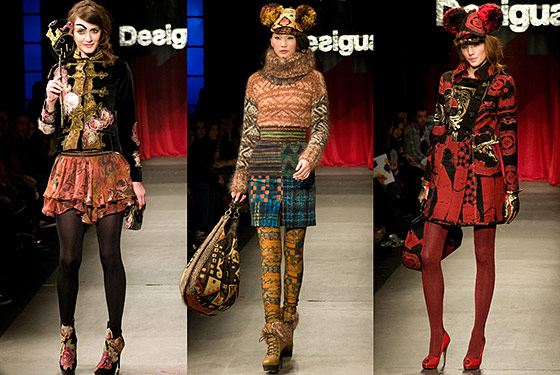
photo via: NY Mag

Although it is nothing new for designers to collaborate with commercial brands, the continuity of this trend shows that such collaborations are here to stay. Designers working for commercial brands is becoming a more common theme. For example, even haute couture designer Christian Lacroix, recently announced it's collaboration with Spanish label Desigual for the Fall 2011 collection. Today, collaborations can happen anywhere and with anyone.

Therefore, the idea of collaboration could be something to seriously reconsider and expand upon.
As collaboration becomes an essential factor in developing unique or special products, one must ask themselves how we can further the idea of  "collaboration" in our own product and idea developments.
Would businesses be reorganizing their internal structures? Perhaps. Would jobs require multi-skilled backgrounds? Most likely. Even in one of our last articles in regards to the birth of the edvitorial, the overall conclusion is the same. We are moving toward more and more of an integrated society, work place, and culture. How are we going to adapt?

Thursday, May 20, 2010

The 2010 Shopper

As we live in a world of excess, mass-market retailers and global conglomerates are the leading figures of today's retail industry. However, as it is with any trend, there is always a backlash. And this past year, we have noticed a growing number of smaller, personalized boutique shops popping up all over major cities, creating intimate shopping experiences for those who want to purchase something that hasn't been replicated by the thousands.

photo via: J.Crew

It seems that as we live in such a globally-saturated, technology-driven society, consumers today want something different in their shopping experience. Rather than going to five floor department stores carrying every brand known to man, cosy settings with small, carefully selected products displayed with crafty art installations seem to be the preferred choice. And it is not just the local, underground shops, well-recognized stores like Anthropologie, the J. Crew Men's Liquor Store, and ABC Home have been much about keeping that intimate store atmosphere, despite the number of their chain stores.

As there are rapid expansions of chain store retailers all over the globe, there is a new, deeper value for things that are local, hand-made, limited, or one-of-a-kind. Although such products may be a bit more costly, consumers today are more careful about their purchases and want something that is special. Because there are so many options for practically everything nowadays, the infinite number of purchasing choices have created a more educated consumer; one who is more particular of what he or she buys, and willing to pay more if it deems worth. With the economic recession and the last several years of globalization and mass-consumption, there is less concern for buying the latest brand name and instead, a greater interest of things that carry a unique story behind it's exterior.

Guy Wolff pottery at Restoration Hardware 

Commercial brands such as J. Crew, Urban Outfitters, and Restoration Hardware, for example, have taken note and recently began collaborations with smaller designers and artists to bring in something unique to their collections. J. Crew just released it's small collection of chain necklaces made in collaboration with NYC-based Dana Lorenz, designer of FENTON and FALLON. Restoration Hardware is selling hand-thrown pottery designed by Connecticut-based artisan Guy Wolff. And Urban Outfitters works with a number of independent designers, with current exclusives from New York designer Ulla Johnson and the NY-LA boutique The Reformation. Although these retail stores still largely carry mass-market products, these small additions help them to stand out amongst the big name brands, while also offering competitive products against the local boutique shops.

And as online shopping is on the rise, there are several websites dedicated to providing hand-made or one-of-a-kind goods. Etsy, the social commerce site is all about building an economy that reconnects makers with buyers, taking advantage of the Internet to allow independent artists, designers, and craftsmen to sell their work in a global market. Culture Label is another, recognizing the importance of a cultural product, carrying handpicked items from artists all over the world. Offering what they call "products with soul", the founders behind Culture Label understand the need for purchases that are beyond mainstream and original in design, integrity, and authenticity.

So for those of us in New York needing to go on a shopping venture, there are a number of great, promising shops that are just walking distances away, and definitely worth checking out. Here we leave you with a short list of our favorites and recently new finds, and we'd love it if you can drop a note and give us your recommendations!

photo via: Albertine
Albertine, 13 Christopher Street

photo via: Refinery29
Maryam Nassir Zadeh, 123 Norfolk Street

photo via: Yatzer
Droog, 76 Greene Street

photo via: Refinery29
No. 6, 6 Centre Market Place

photo via: Refinery29
Kiosk, 95 Spring Street 

photo via: Refinery 29
Pixie Market, 100 Stanton Street

photo via: The Choosy Beggar
King of Greene St, 72 Greene St. 

Wednesday, March 24, 2010

Nothing to Hide

One of the biggest trends of our times is transparency-- and we're not just talking about sheer tank tops or blouses here. What we are seeing is not limited to the runway fashions with trends that may not withstand more than a few months, but rather a cultural shift that is drastically changing the way we live, feel, and think as individuals and active members of society.

As we have many times discussed the rising popularity of social media networks and technological advancement of all industries, along with these is more openness and transparency. Networks like Facebook, Twitter, and LinkedIn have become so integrated with how we interact with others, both in our personal lives and business, that we are now accustomed to, and even expect, to have access to what everyone is up to and letting others know about us. As communication is becoming faster, wider, and easier, people seem to be less concerned about invasion of privacy, or at least there is now a whole new set of standards.

                              Cast of Kell on Earth via: Pop Tower

In turn, this mentality has affected every industry in the way companies market themselves and interact with their customers. The fashion industry has become more open with what goes "behind-the-scenes"
as fashion-related reality TV shows have increased in popularity with new shows coming up every year, like this year's newest hits Kell on Earth and Launch My Line. There is also more openness in the retail segment. Last year, the always forward Opening Ceremony created a blog, giving a behind-the-scenes knowledge of their staff, collections, and personal interests. And more recently, J. Crew began sharing a selection of clothing handpicked by their creative director, giving a more personal shopping experience to their clients, as well as interviews with their favorite muses, sharing who and what inspires them.

                                                via: J. Crew

In addition, there is also a growing number of websites designed exclusively to review a product or company. Trip Advisor, for example, is one of the most popular and trusted travel review sites today, boasting with over 30 million reviews on more than 490,000 hotels and attractions, with over 45 million monthly visitorsYelp, attracting 26 million monthly visitors with over 9 million local reviews, has also become the go-to site to review practically anything in any US city, whether it's which restaurant to dine at, which mall to shop, or which dentist to go to. But there are also more specific review sites like MakeupAlley.com, dedicated to reviewing beauty products, or MySears.com, focused solely on reviewing Sears products.

As we live in a globally connected society where communication is all about real time, the future of any industry is all about having real conversations with their customers and knowing how to best respond to it. Simply put, consumers are better educated, and they want to know more. As more information is available, people are more interested in the bigger picture of things as it is no longer just about the final product. A company's stance on health, social, ethical, and eco responsibility all have a say in the final purchase.

There are now many tools designed to help support this. Shopsavvy, an Android app, allows one to scan almost any barcode using the phone's camera, and it will then search over 20,000 online and local retailers to find the best price. Fatburgr, a website and iPhone application, allows one to search the nutritional facts of almost every fast-food restaurant. One of our favorites is the GoodGuide, a website and iPhone application providing information for the eco-conscious consumer, evaluating the life cycle of over 70,000 products. Project Label is another, creating "people-powered company nutrition labels", showing a company's social and environmental impact. Using the power of the web, the site allows consumers, businesses, and organizations to add, discuss, and vote on credible news, media, and research to help build these labels.

                                            via: Inhabitat

With websites and tools like these, it is only more beneficial for companies to be more transparent about their business practices and take more responsibility. As there is a growing number of websites such as these, there is very little room to hide and much less space for error.

And since we've mentioned Walmart in our previous post, we want to point out that last July, they announced plans to develop a sustainable product index, evaluating the sustainability of all their products. Beginning with a survey of its more than 100,000 suppliers, they plan to focus on four specific areas: energy and climate; material efficiency; natural resources, and; people and community. Walmart's president and CEO has a clear vision of the future, stating, "[Customers] want information about the entire life cycle of a product so they can feel good about buying it. They want to know that the materials in the product are safe, that it was made well and that it was produced in a responsible way. We do not see this as a trend that will fade. Higher customer expectations are a permanent part of the future."

We can't help but agree more. As transparency becomes more in demand, tools that help sustainable consumption is integral. And overall, it's becoming more difficult to separate technology with sustainability as the two are extremely interlinked. In order for brands and products to succeed today, overcoming scrutiny and withstanding a society that demands so much, companies must think more strategically; and that means being more engaged with their customers, being more honest, and ultimately being more responsible.

Thursday, October 22, 2009

Rallying around the Garment District

Yesterday's "Save the Garment Center" rally was well-attended — by fashion students, garment workers, and even high-end designers, reports the NYT — but it looks like the district could already be making a comeback. In a far cry from this summer — when Mayor Bloomberg proposed to consolidate the entire NYC garment industry into a single building — the city is now sponsoring incubator studios for young designers, who will be selected in a competition.

The 12 lucky winners will not only get a two-year lease at below-market rent in a shiny new architect-designed space, but will also receive counseling from the CFDA, making this something like a real-life Project Runway. Of course, for the landlords involved, even more than for the designers, it's a win-win situation: the floor being used for the incubator project was standing empty anyway.

Via The Cut; photo via NYT